

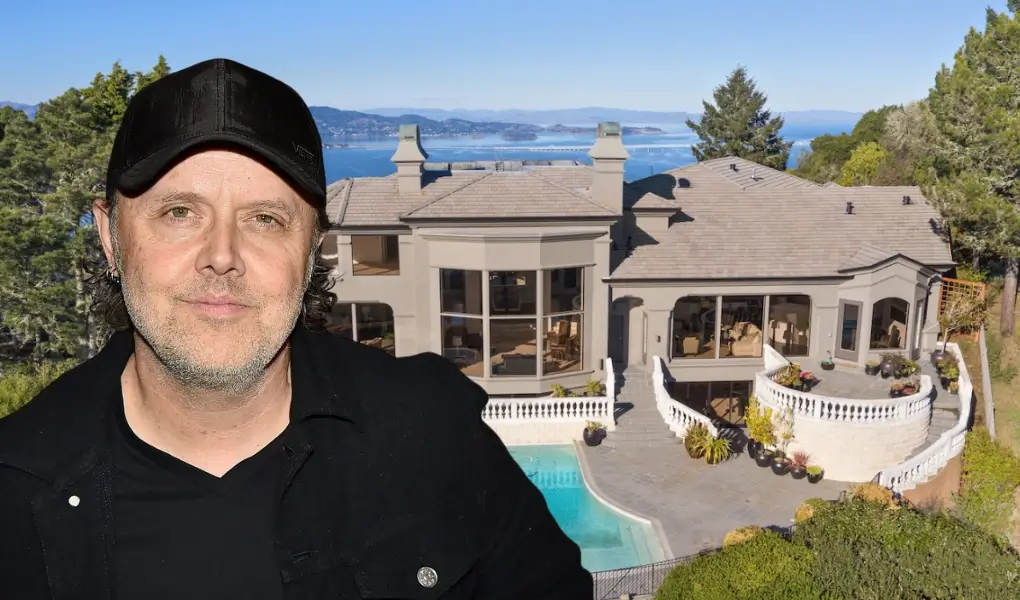
Lars Ulrich lives in San Francisco, California. His exact residence remains private, but a 2023 Los Angeles Times interview confirmed that the Metallica drummer maintains a home in the city.
His best-known property was a gated hilltop mansion in Tiburon, across San Francisco Bay. Ulrich bought the estate in 1993 and sold it for $10.3 million in January 2020. Inside, it featured a recording studio, underground sports court, sauna, media room, art facilities, and panoramic bridge views.
Accuracy note: Lars Ulrich’s documented California real estate is connected to San Francisco and Tiburon. Reliable property coverage does not establish a Lars Ulrich house in Topanga, California.
Lars Ulrich House Quick Facts
| Detail | Information | Record type |
|---|---|---|
| Current home base | San Francisco, California | Confirmed through interview |
| Exact current address | Private | Not publicly disclosed |
| Best-known former home | Tiburon, Marin County | Property and media records |
| Year purchased | 1993 | Public-record reporting |
| Initial 2019 asking price | $12 million | Listing coverage |
| Final sale price | $10.3 million | Recorded transaction |
| Sale date | January 22, 2020 | Public records |
| Recorded living area | 9,753 square feet | Property database |
| Marketed size | More than 13,000 square feet | Listing materials |
| Main residential lot | Approximately 0.46 acres | Property database |
| Complete offering | Three adjoining parcels | Listing coverage |
| Bedrooms | Seven in current property records | Property database |
| Major amenities | Studio, sports court, sauna, pool, art storage | Listing coverage |
| Childhood home | Hellerup, Denmark | Architectural records |
Where Does Lars Ulrich Live?
Lars Ulrich lives in San Francisco, California. A 2023 interview described him speaking from his San Francisco home. His precise address, purchase price, and current property features remain private.
His former Tiburon mansion is no longer his residence. The estate changed ownership in January 2020 after selling for $10.3 million.
San Francisco also keeps Ulrich close to Metallica’s long-established Bay Area base. The band relocated to the region during its early career and has remained closely associated with Northern California.
Inside Lars Ulrich’s Former Tiburon Mansion
Ulrich’s former mansion stood near the end of a gated cul-de-sac in Tiburon. Its elevated position provided extensive views across San Francisco Bay.
Large windows framed the Golden Gate Bridge, Bay Bridge, city skyline, and surrounding water. The views were not simply decorative. They were a central part of the estate’s design and market value.
The property entered the market privately for $12 million in 2019. It was offered as a pocket listing, which meant it was not widely advertised through the standard multiple listing service.
Recorded Size Versus Marketed Size
The mansion has two widely published size figures.
| Measurement | Figure | What It Represents |
|---|---|---|
| Recorded living area | 9,753 square feet | Current property database figure |
| Marketed estate size | More than 13,000 square feet | Broader listing measurement |
| Main residential lot | 0.46 acres | Lot attached to the main house |
| Full offering | Three parcels | Main house plus adjoining land |
Realtor.com records 9,753 square feet, seven bedrooms, more than six bathrooms, and a four-car garage. It also lists the home as built in 1988.
The larger marketed figure may have included finished underground rooms, recreation spaces, storage areas, or other usable sections excluded from official living-area calculations.
For celebrity real estate analysis, these measurements should not be treated as interchangeable. The recorded figure supports valuation comparisons. The marketed figure describes the property’s broader usable footprint.
Why the Three Parcels Mattered
The sale included the main residence and two adjoining parcels.
Extra land in Tiburon provides more than a larger garden. It can protect views, reduce nearby development, create separation from neighbours, and increase long-term privacy.
That matters because the estate’s strongest asset was its position above the bay. A new structure on neighbouring land could have affected both privacy and sightlines.
For a high-net-worth buyer, controlling nearby parcels can be as valuable as adding another room to the house.
Inside the Recording Studio, Sports Court, and Art Rooms
The estate included amenities linked directly to music, collecting, entertainment, and private recreation.
Documented features included:
- A private recording studio
- An underground basketball and squash court
- A media room
- A games room
- A six-person sauna
- A library
- Five fireplaces
- An art studio
- Dedicated art storage
- An aquarium positioned above a bathtub
- A swimming pool and spa
- A four-car garage
These features were included in coverage from Mansion Global, the San Francisco Chronicle, and reports on the completed sale.
The Recording Studio Also Served as a Safe Room
The private recording studio reportedly had a second function as a secure room.
This was a practical combination. Recording studios already require thick walls, controlled access, insulation, and limited exterior openings.
Those same features can support privacy and security without adding a separate fortified room.
A home studio also allowed Ulrich to work without travelling to a commercial facility. For a touring musician, that improves scheduling, privacy, and creative flexibility.
The Underground Sports Court
The mansion’s underground court supported basketball and squash.
Placing a large recreation room below ground reduced its impact on the exterior architecture. It also helped separate sports noise from the main living spaces.
The feature came with practical costs. Underground facilities need reliable ventilation, drainage, waterproofing, and moisture control.
Those systems become especially important on a hillside property. Repairs can be disruptive and expensive when recreation rooms sit below grade.
Dedicated Space for an Art Collection
Ulrich’s interest in fine art made the studio and storage rooms more useful than a standard mansion gallery.
Large walls are suitable for displaying paintings, but serious collections also require secure storage. Temperature, lighting, access, and handling conditions can affect long-term preservation.
The Tiburon estate supported both presentation and management. That made the art areas functional rather than purely decorative.
How the Architecture Used Its Hilltop Setting
The home was built in 1988 and was often described as a modern European-style château.
Its design combined formal scale with extensive glazing. Tall ceilings and large rooms supported entertaining and art display, while the windows kept the interior connected to the bay.
Why the Views Drove the Estate’s Value
In Tiburon, elevated homes can command a premium when they offer privacy and uninterrupted water views.
The Ulrich estate looked toward several of the Bay Area’s most recognisable landmarks. This made the setting difficult to reproduce.
A large mansion can be built in many luxury markets. An unobstructed view of San Francisco, the Golden Gate Bridge, and the surrounding bay is far scarcer.
This is one major difference between Tiburon and Beverly Hills. Beverly Hills estates often compete through land, landscaping, and proximity to entertainment centres. Tiburon’s strongest properties compete through elevation, waterfront access, and panoramic views.
How the Mansion Balanced Work and Entertainment
The house addressed four main lifestyle needs:
- Creative work: A private recording studio
- Entertainment: Media and games rooms
- Recreation: Sports court, pool, spa, and sauna
- Collection management: Art display and storage areas
This combination made the property highly personal.
It was not simply a large house filled with luxury finishes. Its spaces reflected the owner’s professional work and private interests.
The Hidden Costs of a Hilltop Estate
The mansion’s setting and amenities also increased ownership costs.
Hillside construction may require more foundation, drainage, and retaining-wall maintenance. Extensive windows require regular cleaning and climate control.
The underground court and specialised studio added further mechanical and structural complexity.
These features are valuable to a buyer who plans to use them. They may be less appealing to someone who would need to convert or maintain unfamiliar spaces.
Lars Ulrich’s Purchase and Sale Timeline
- 1993: Ulrich purchased the Tiburon property.
- 2007: Ownership was transferred into a trust connected to Ulrich.
- 2019: The estate entered the market privately for $12 million.
- January 22, 2020: The property sold for $10.3 million.
- 2023: Ulrich was interviewed from his San Francisco home.
- 2024: His childhood home in Hellerup entered the market for 48 million Danish kroner.
The Tiburon sale price was $1.7 million below the initial asking price.
That difference does not necessarily indicate a weak asset. Highly customised estates often take longer to sell because they appeal to a smaller group of buyers.
The final transaction still placed the property well above Tiburon’s typical residential market.
Why the Property Was Held Through a Trust
Property coverage stated that the mansion was controlled through a trust before its sale.
Trust ownership is frequently used for valuable real estate because it can support estate planning, succession, and asset administration.
It may also reduce how prominently a celebrity’s name appears in basic property searches. However, trusts do not always make ownership completely anonymous.
The specific financial and legal terms of Ulrich’s trust were not publicly disclosed. It would therefore be inaccurate to claim a particular tax benefit or protection strategy.
The Estate’s Current Market Position
The former Ulrich estate remains off the market. Current property databases continue to show the 2020 sale as its most recent transfer.
Automated estimates have placed the property below its $10.3 million sale price. However, automated models are less reliable for unusual luxury estates.
They may not fully capture:
- The value of adjoining parcels
- Protected view corridors
- Specialised recreation rooms
- The recording studio
- Art storage facilities
- Celebrity provenance
- The scarcity of the hilltop setting
For the three months ending May 2026, Tiburon’s median home sale price was approximately $3.1 million. The former Ulrich mansion’s 2020 price was more than three times that benchmark.
This comparison places the estate firmly in Tiburon’s ultra-luxury tier. It does not provide a precise current appraisal.
Lars Ulrich’s Childhood Home in Denmark
Ulrich spent his childhood in a large brick villa in Hellerup, an affluent area near Copenhagen.
Danish architect Carl Brummer designed the property in 1907. The home later gained protected status because of its architectural importance. Ulrich lived there during the first 17 years of his life.
The villa returned to the market in 2024 with a price of 48 million Danish kroner, then equal to about $6.85 million.
This was Ulrich’s childhood home, not a property he personally listed.
Tiburon Estate Versus Hellerup Childhood Home
| Feature | Tiburon Estate | Hellerup Villa |
|---|---|---|
| Property type | Modern luxury mansion | Protected historic villa |
| Connection to Ulrich | Former adult residence | Childhood home |
| Main value driver | Views, privacy, and amenities | Architecture and heritage |
| Public price | Sold for $10.3 million | Listed for DKK 48 million |
| Design focus | Music, recreation, and art | Historic residential architecture |
The properties represent two different forms of luxury.
The Tiburon mansion was customised around lifestyle and work. The Hellerup home derives much of its value from architectural heritage and location.
What Lars Ulrich’s Real Estate Reveals
Ulrich’s former Tiburon mansion shows why celebrity homes often function as both residences and private infrastructure.
The recording studio supported professional work. The art rooms supported collection management. The sports court, sauna, pool, and media room reduced the need to use outside facilities.
The adjoining land also strengthened privacy and protected the estate’s most important feature: its view.
For wealthy owners, these benefits can justify high purchase and maintenance costs. They can also narrow the resale market because future buyers must value the same specialised spaces.
Frequently Asked Questions
Where does Lars Ulrich live?
Lars Ulrich lives in San Francisco, California. A 2023 Los Angeles Times interview was conducted with him from his San Francisco home. His exact address and current property details remain private. He sold his former Tiburon mansion in January 2020.
Did Lars Ulrich live in Topanga, California?
Reliable property reporting does not establish a Lars Ulrich residence in Topanga. His documented California real estate is connected to San Francisco and Tiburon. His best-known property was the Tiburon mansion he purchased in 1993 and sold in 2020.
How much did Lars Ulrich’s house sell for?
Lars Ulrich’s former Tiburon mansion sold for $10.3 million on January 22, 2020. The property had entered the market for $12 million through a private pocket listing. The final sale price was $1.7 million below the original asking price.
How big was Lars Ulrich’s Tiburon house?
Realtor.com records 9,753 square feet of living space, seven bedrooms, and more than six bathrooms. Listing coverage marketed the broader estate at more than 13,000 square feet. The difference likely reflects how usable and underground areas were classified.
What amenities were inside the mansion?
The mansion included a recording studio, underground basketball and squash court, media room, games room, sauna, library, art studio, art storage, swimming pool, spa, and four-car garage. One bathroom also featured an aquarium above the bathtub.
Does Lars Ulrich own his childhood home?
Lars Ulrich does not own the Hellerup villa associated with his childhood. The historic Danish property was offered for sale by its owners in 2024. Ulrich lived there during the first 17 years of his life.
