

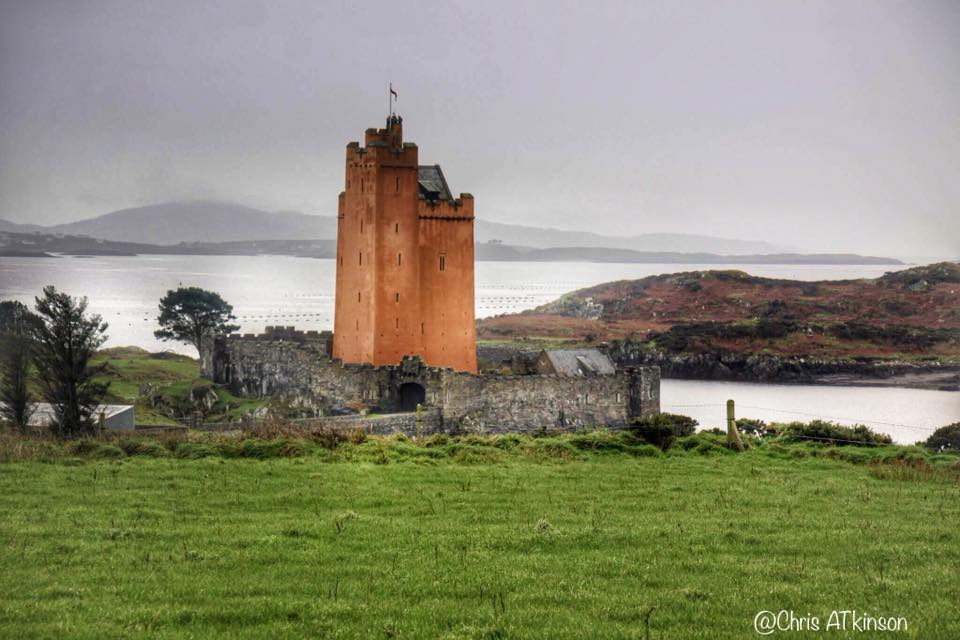
Most Hollywood stars buy modern mansions in Beverly Hills. Jeremy Irons bought a ruined 15th-century castle on a tiny island in Ireland. Kilcoe Castle, perched on Mannin Beg in West Cork’s Roaringwater Bay, is one of the most extraordinary celebrity homes in the world. It took the Oscar-winning actor six years to bring this medieval fortress back from centuries of decay, creating a residence that is equal parts historic monument and personal masterpiece.
Kilcoe Castle as it appears today, restored to its striking ochre exterior. Photo: Wikimedia Commons.
Quick Facts About Kilcoe Castle
| Location | Mannin Beg island, Roaringwater Bay, West Cork, Ireland |
| Built | c. 1458 by the MacCarthy clan |
| Purchased | 1997 by Jeremy Irons for IR£150,000 |
| Restoration | 1998–2004 (6 years), cost approximately £1 million |
| Property Size | 0.81 hectares (2 acres) island |
| Main Tower Height | 65 feet (main tower), 85 feet (turret) |
| Sleeping Capacity | 13 people |
| Notable Feature | Terra-cotta/ochre limewash exterior |
| Current Status | Private residence of Jeremy Irons |
The History of Kilcoe Castle
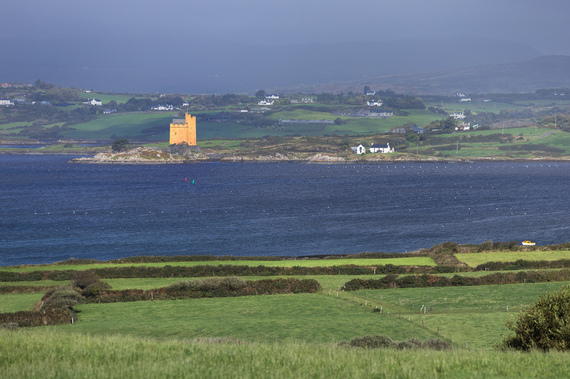
Kilcoe Castle was built around 1458 by the MacCarthy clan, one of the most powerful Gaelic families in medieval Ireland. It served as the residence of the chief of Clan Dermot MacCarthy, who ruled over vast territories in West Cork. The castle’s strategic location on a small rocky island in Roaringwater Bay gave it natural defenses on all sides, with commanding views of the bay and the Atlantic coastline beyond.
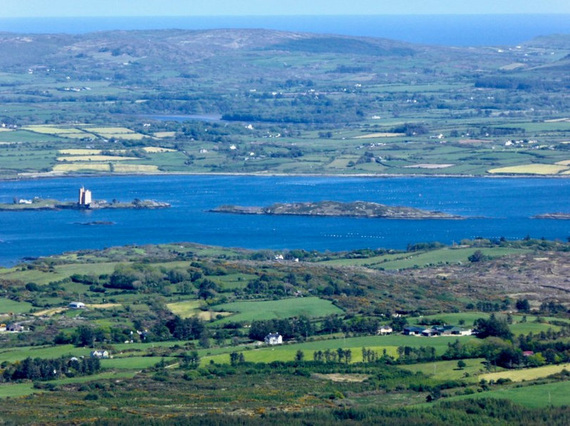
Kilcoe Castle sits on its island in Roaringwater Bay, connected to the mainland by a short causeway. Photo: Roaringwater Journal.
The tower house was one of the last Irish castles to fall to English forces. It held out until the early 1600s, in the aftermath of the Battle of Kinsale, which sealed Elizabethan England’s conquest of Gaelic Ireland. Crown forces approached on horseback and by sea, armed with muskets and swords. After its capture, the castle was gradually abandoned and fell into disrepair over the next four centuries. By the time Jeremy Irons encountered it, Kilcoe was a roofless ruin covered in grass and wild shrubbery, its uppermost floors exposed to the harsh Atlantic weather.
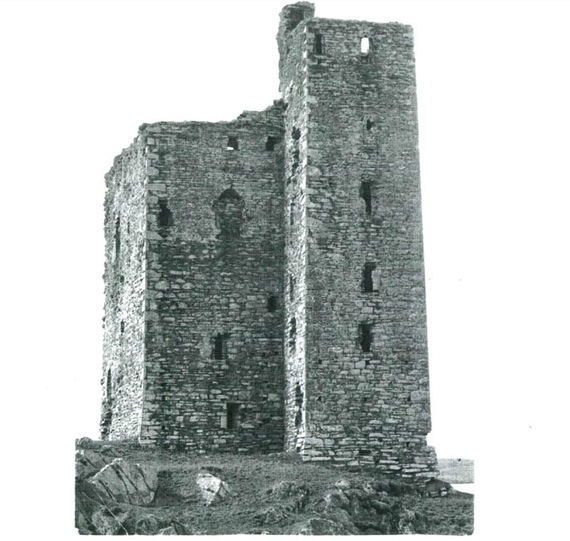
Kilcoe Castle before restoration, a crumbling ruin on the West Cork coast. Photo: Roaringwater Journal.
In 1996, the castle was offered for sale. Despite some local protests against transferring a historic site to private ownership, the land and castle were purchased in 1997 for IR£150,000. The buyer was Jeremy Irons, who had already been living in a nearby cottage called Teach Iasc (Irish for “Fish House”) with his wife, the actress Sinéad Cusack. They had spent years exploring the islands and waterways of West Cork by boat, and the ruin of Kilcoe had become a favorite picnicking spot where Irons and his sons would scamper up the walls to view the bay from perilous heights.
A Six-Year Labor of Love: The Restoration Process
The restoration of Kilcoe Castle began in 1998 and took six years to complete, wrapping up in 2004. What makes this project remarkable is that Irons oversaw it himself, without a credentialed architect, general contractor, or medievalist at his side. As Irons described it, “It was a load of amateurs setting to, following our noses.” At any given moment, 30 to 40 people worked on the site, a motley assemblage of local craftsmen, itinerant masons, personal friends, and even wandering tradesmen who had heard about the project and showed up looking for work.
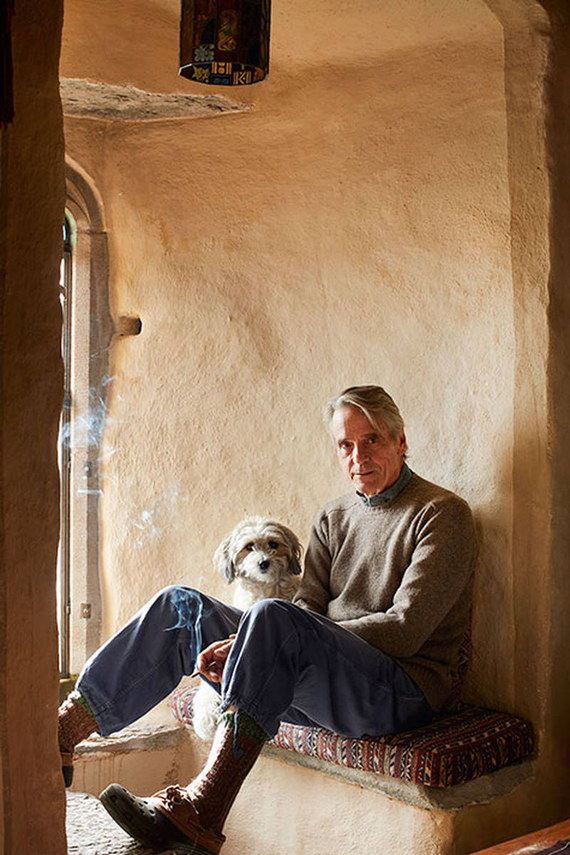
Jeremy Irons with his dog Smudge at Kilcoe Castle. Photo: 1stDibs / Simon Upton.
Irons hired Bena Stutchbury as his de facto architect and administrator. She had only 12 weeks of formal training, having been taken on as a trainee by her father, the architect Wycliffe Stutchbury, before his sudden death. For the position of project foreman, Irons brought in Brian Hope, his longtime property manager from Oxfordshire. Together, this unconventional team tackled one of the most ambitious private castle restorations in Irish history.
The restoration budget exceeded £1 million. Irons bought rather than rented all the equipment: tiers of scaffolding, a crane, a generator, a forklift. He set up a work yard beside the causeway with a blacksmith’s workshop, a stonemason’s workshop, and a carpentry workshop. His dedication to preserving the original structure was absolute. He insisted on using lime mortar instead of modern cement. He refused to drill holes in the external masonry. When he noticed twig-like striations in the mortar on the barrel-vaulted ceiling, he researched and discovered that medieval builders used woven wicker panels to form arched ceilings. This discovery inspired the ornate wickerwork that now appears throughout the castle, created by the German-born weaver Katrin Schwart.
The “Pink” Castle Controversy
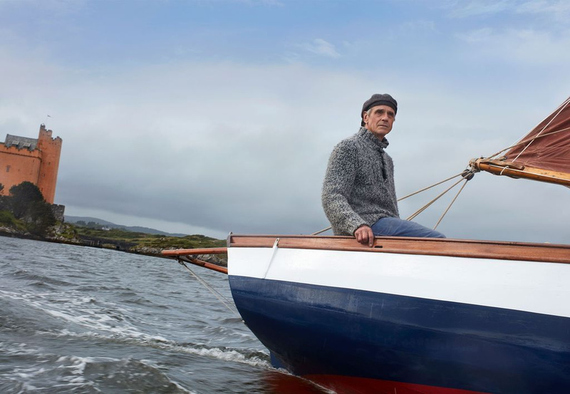
The distinctive ochre exterior of Kilcoe Castle that sparked the “pink castle” controversy. Photo: Vanity Fair / Simon Upton.
Perhaps no aspect of Kilcoe Castle has drawn more attention than its exterior color. The original plan was to leave the castle as weathered gray stone. But no amount of pointing and repointing could keep the interior dry. Despite walls approximately five feet deep, the fierce winter winds and rain of Roaringwater Bay created puddles the size of a car in the main living area. The walls needed to be harled (covered in a thick layer of lime mortar) and then coated with limewash.
Irons first tried a cream-colored limewash, but it made the castle “look a bit like a vibrator,” as he memorably told Vanity Fair. He ultimately had the outermost coats mixed with iron sulfate, a compound that goes on pale green but turns rust-colored with oxidation. The result is a warm terra-cotta or ochre hue that changes character with the light. In the years since, Irons’ ochre-rust version of Kilcoe has become a beloved West Cork landmark, its warm coloring and bayside positioning making it look as if it sits in a perpetual golden twilight.
However, for a time in the early 2000s, English and Irish newspapers made a scandal of the new finish. A Telegraph reporter claimed locals were angry at the castle’s “sudden transformation from weathered gray to warm pink.” Irons dismisses these stories as nonsense and passionately corrects anyone who calls the color pink. The building is ochre, he insists, and even at dusk you would have to be “lysergically loaded” to see it as pink. The controversy has only added to Kilcoe’s mystique, and today the distinctive color is widely celebrated as historically authentic to how medieval Irish castles would have appeared.
Step Inside: The Interior of Jeremy Irons’ Home
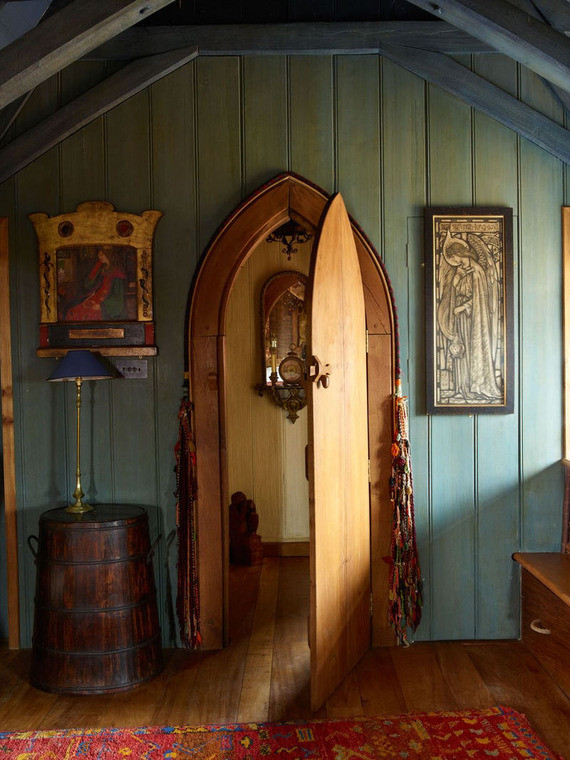
The Solar, the castle’s double-height main living area, filled with eclectic art and furnishings. Photo: Vanity Fair / Simon Upton.
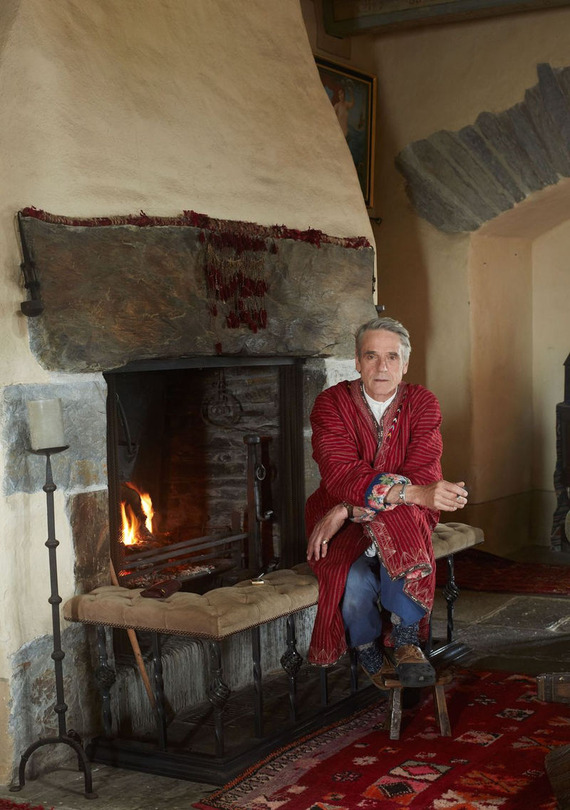
Kilcoe Castle sleeps 13 people, with most bedrooms and bathrooms tucked away in the five-story turret. The castle’s showpiece is the Solar, the double-height main living area located on the third floor of the main tower. Making use of the tower’s full width and depth (roughly 32 by 40 feet), the room is a marvel of eclectic design. It assimilates all manner of art and materials Irons collected during his travels: Moroccan carpets, a Nepalese camel yoke, an old Roman-style threshing board called a tribulum, a fiddle he had made in Slovakia, and a life-size antique wooden horse that he found in the Cotswolds.
The Solar benefits from a surprising amount of natural light. Its tall, oblong windows are aligned precisely to the north, south, east, and west, offering panoramic views of the bay and surrounding countryside. At the center of the room, beneath a wrought-iron chandelier from France, sits a conversation pit bounded by a large hearth and two sofas upholstered in celadon-colored Liberty’s of London fabric (applied backwards for a subtler texture). Overlooking the Solar on all four sides is a gallery that supplies additional living space: a library and office on the western side, and an intimate den with a grand piano, a woodstove, and a TV nook on the eastern side.
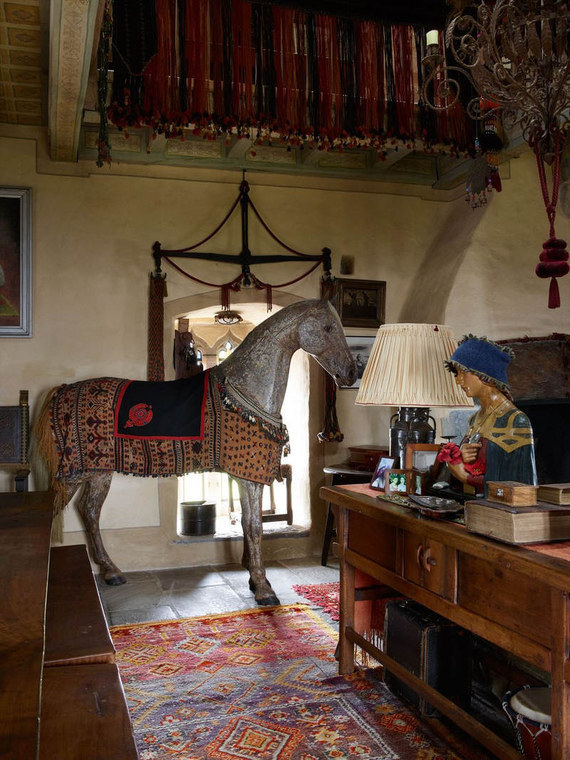
The Solar’s gallery overlooking the main living space, with the famous life-size wooden horse. Photo: Vanity Fair / Simon Upton.
The Master Bedroom and Guest Rooms
Irons’ master suite sits atop the Solar and gallery, a sort of deluxe captain’s quarters. Its elaborate, arching wood roof is inspired by the attic of an 11th-century farmhouse Irons stayed in while filming The Man in the Iron Mask in France. “I love it because it’s like being inside an upturned boat,” he said. The bed hangs from the ceiling, and the wickerwork by Katrin Schwart appears on the headboard and even on the outer frame of his bathtub.
Guest rooms feature woven willow ceilings crafted by Schwart, continuing the medieval wicker motif throughout the castle. Irons’ love of salvaging is evident everywhere. He chipped hexagonal Carrara marble tiles out of a demolished house in Hampstead and repurposed them in Kilcoe. His personal bathroom features intricate, wavy woodwork carved by an Argentinean carpenter who once worked on the project.
A guest bedroom featuring Katrin Schwart’s ornate wickerwork ceiling. Photo: Vanity Fair / Simon Upton.
Does Jeremy Irons Own Other Homes?
Yes. While Kilcoe Castle is his most famous property, Jeremy Irons maintains several other residences. His primary home is a Grade II-listed house and barn in Watlington, Oxfordshire, where he has lived for over 35 years. In recent years, Irons has been actively involved in the Watlington community, helping renovate a property to house Ukrainian refugees and forming a local support group. He also owns a residence in The Liberties area of Dublin, a mews house in Notting Hill, London, and a home in his birth town of Cowes on the Isle of Wight. The West Cork cottage known as Teach Iasc, where he and Cusack originally stayed before purchasing Kilcoe, also remains in his portfolio.
As of recent reports, Irons continues to divide his time between these properties, with Kilcoe Castle remaining his most cherished retreat. The castle has become a landmark in West Cork, admired by locals and visitors alike. Its restoration is widely regarded as one of the finest private conservation projects in Ireland, and it stands as a testament to what vision and perseverance can achieve.
Frequently Asked Questions
Where is Jeremy Irons’ castle located?
Kilcoe Castle is located on Mannin Beg, a small rocky island in Roaringwater Bay, between Ballydehob and Skibbereen in West Cork, Ireland. The island is connected to the mainland by a short causeway.
How much did Jeremy Irons pay for Kilcoe Castle?
Irons purchased Kilcoe Castle and the surrounding island in 1997 for IR£150,000 (Irish pounds). The restoration that followed cost approximately £1 million.
Why is Kilcoe Castle that color?
The exterior is coated with limewash mixed with iron sulfate, which oxidizes to a warm ochre or terra-cotta color. This was both a practical necessity (to weatherproof the walls) and a historically informed choice by Irons, who argues that medieval castles were colorful, not gray.
Can you visit Kilcoe Castle?
No. Kilcoe Castle is a private residence and is not open to the public. It can be viewed from a distance from the surrounding roads and waterways in Roaringwater Bay.
How long did the restoration take?
The restoration took six years, beginning in 1998 and completing in 2004. At its peak, 30 to 40 workers were on site at any given time.
What style is the interior of Kilcoe Castle?
Irons describes the approach as “a jazz theme on the medieval.” The interior blends preserved medieval features (barrel-vaulted ceilings, slit windows, wickerwork ceilings) with eclectic global furnishings, salvaged materials, and modern amenities including hot water, electricity, and Wi-Fi.
